
Canada has introduced new revisions to its Organic Standards, the framework that guides the operation of organic farms nationwide. While these standards initially focused primarily on environmentally responsible and sustainable agriculture, they also play a key role in shaping the quality of life of animals raised on organic farms.
Organic farms are considered one of the gold standards for farmed animal welfare in Canada. While the National Farm Animal Care Council (NFACC) Codes of Practice set nationally developed minimum standards of care for farmed animals, organic standards go a step beyond this by implementing higher–welfare measures.
Animals must be provided with outdoor access, species‑specific environmental enrichment, and increased indoor space allowances compared to conventional systems. Restrictive housing, such as cages for laying hens and gestation stalls for sows, is prohibited. Painful procedures are also restricted and may be performed only when necessary, with appropriate pain control measures in place. The table below clearly shows the comparison between the two systems.
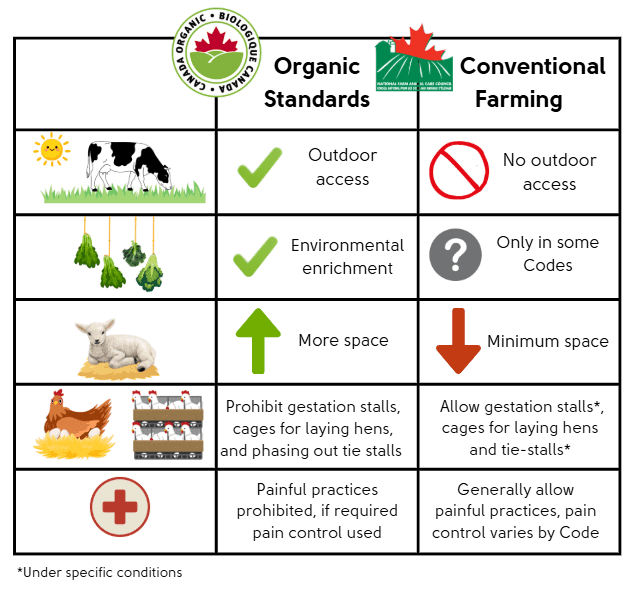
Improving the welfare of farmed animals is a priority for the BC SPCA. The Organic Standards undergo a formal review every five years to ensure they remain aligned with current scientific knowledge and public expectations. The BC SPCA plays an active role in the review process, with Melissa Speirs, manager, farm animal welfare, serving on the Technical Committee, which updates the standards. We also invite our community to share their feedback during the public comment period.
“Organic foods are some of the most accessible higher welfare foods in Canada,” says Speirs, “Consumers who value animal welfare can choose organic and be sure they are choosing products from farms that were independently inspected, animals were able to go outdoors, have more space, and express more of the behaviors that are important to them, among other important benefits.”
Improvements that the BC SPCA is happy to see in the update:
- Animal handling standards emphasize low-stress, calm handling through training, proper facility maintenance, and acceptable equipment. Electric prod use has been further restricted to emergencies only.
- Environmental enrichment requirements for when animals are housed indoors. All animals must have daily access, and suitable species-specific examples are provided.
- Unweaned dairy calves must be housed in pairs or groups to meet their social needs.
- Reducing the time sows can be confined in gestation or farrowing crates. Confinement of sows in gestation or farrowing crates is prohibited, except for periods of temporary restraint to a maximum of four hours (previously up to three days was permitted).
Learn more by reading the full Organic Standard here.
Are you passionate about farm animal issues? Subscribe to FarmSense newsletter.
The BC SPCA uses your personal information to update you on our work for animals as well as for advertising and analytics purposes. More information on uses and how to opt-out can be found in our Privacy Policy.