
While domestic donkeys are not native to Canada, they have proven to be extremely adaptable to our diverse climate and ways of living. For thousands of years, donkeys have played a vital role in human life. Across many different cultures, they have been used as a primary source of work and transport. In Canada, there are over 6,000 donkeys and mules living on farms. They are often used as “livestock guardians” for animals such as sheep, goats, and cattle, but they’re also kept for recreation and companionship. Let’s dive into some fun facts about them.

1. Donkeys belong to the Equidae family
The Equidae family also includes horses and zebras. Though they’re separate species today, they all share a common ancestor that lived millions of years ago. Because of their close relation, donkeys and horses can even breed together, their offspring is called a mule.
2. Donkeys have impressive memories
Donkeys can remember other animals, people, and places they’ve encountered, even years later. Their exceptional memory helps them navigate challenging environments and maintain lasting social bonds.
3. Donkeys are social animals
Donkeys form close, lifelong bonds with one another. Studies show that separation from a bonded partner can trigger high stress responses, affecting both their behavior and physical health.
4. Donkeys communicate through vocalizations
Donkeys use a variety of sounds, most famously their loud “bray”, to express emotion and communicate over long distances. They can vocalize while both inhaling and exhaling, allowing their call to carry as far as three kilometres.
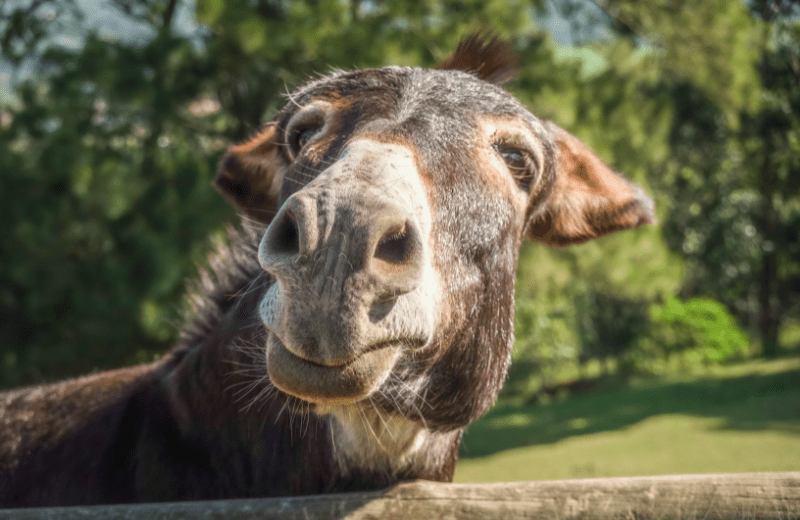
5. Donkeys express emotions through facial expressions
Non-verbal communication plays a big role in donkey behavior. Like horses, their ears, eyes, and facial muscles convey how they feel. Learning to read these subtle cues helps people care for them more effectively.
6. Donkeys are built for resilience
Domesticated donkeys are descendants of the African wild donkey, a critically endangered species that evolved to survive in harsh desert conditions. Their ability to cope with heat, drought, and rugged terrain makes modern donkeys remarkably resilient animals and adaptable to the Canadian climate.
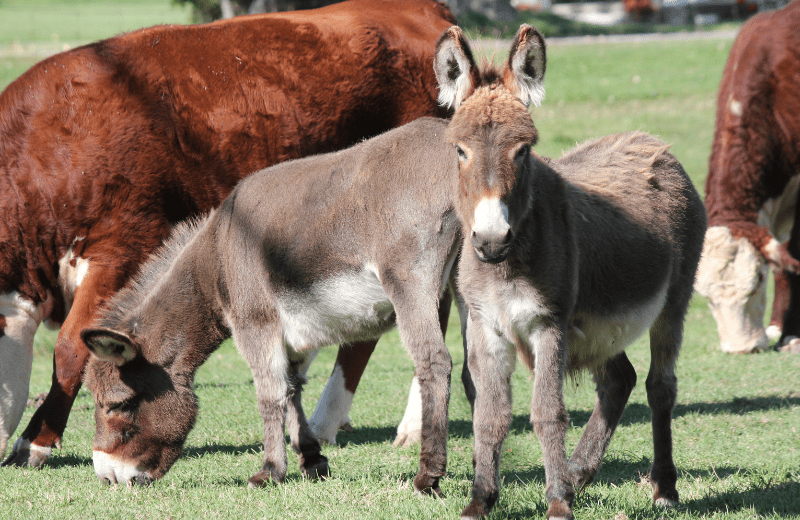
7. Donkeys protect other animals
Donkeys are often used as “livestock guardians,” protecting sheep, goats, and even cattle from predators like foxes and coyotes. Their keen senses, loud bray, and strong defensive instincts are one way farmers protect their herds from predators.
8. Donkeys are intelligent and have a strong sense of self-preservation
Donkeys are intelligent problem-solvers that are very observant of their surroundings. Unlike horses, they don’t immediately flee when startled, instead, they pause to evaluate the situation. Their cautious behavior often leads them to take a “fight” response rather than “flight,” which is why donkeys are sometimes mistaken for being stubborn.
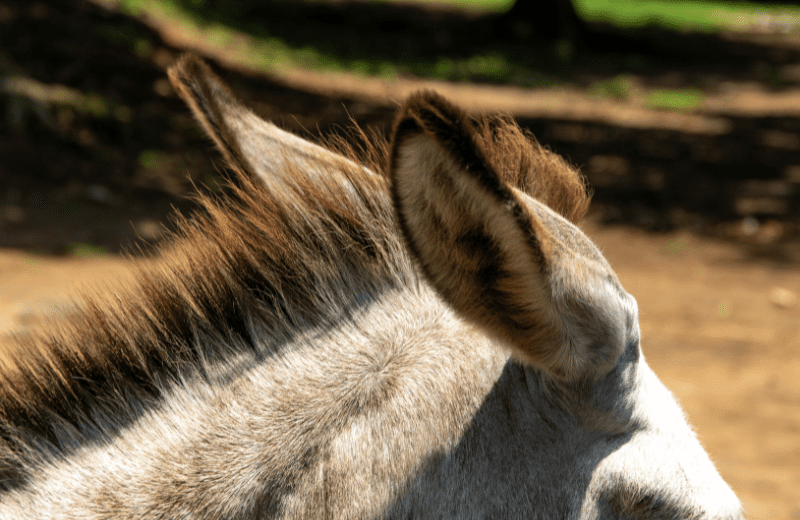
9. Their ears help them stay cool
A donkey’s large ears aren’t just for hearing! Their wide surface area and network of blood vessels help release body heat, keeping them cool on warmer days.
10. Miniature vs. mammoth donkeys
Donkeys come in all shapes and sizes! Miniature donkeys stand just over 0.60 meters (2 feet tall) at the shoulder and are often kept as pets or used in therapy programs because of their gentle nature. At the other end, mammoth donkeys can tower up to 1.7 meters (5 feet 8 inches tall). Historically, they were used for heavy work, like hauling loads and plowing fields, due to their strength and endurance.
Donkeys are truly unique, intelligent, and resilient animals. We are always working towards a better future for all farmed animals in B.C. and across Canada, but we need your help. Currently, the Code of Practice for the Care and Handling of Equines is being updated and public comment period is open until March 12, 2026. Anyone can participate, and public input will help inform the final Code. To stay up to date when the draft Code is ready for public comment, subscribe to our Action Alerts.
Subscribe to FarmSense newsletter
FarmSense is delivered four times a year and includes news about farmed animal welfare and updates on what the BC SPCA is doing to help further animal welfare in Canada.
The BC SPCA uses your personal information to update you on our work for animals as well as for advertising and analytics purposes. More information on uses and how to opt-out can be found in our Privacy Policy.