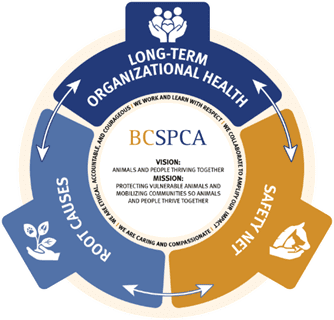
Last year, the British Columbia Society for the Prevention of Cruelty to Animals (BC SPCA) launched its 2025-2030 strategic plan with the vision where animals and people are thriving together across the province: through addressing the root causes of animal suffering, while continuing to be a safety net for the most vulnerable animals. “In 2025, the BC SPCA team helped more than 134,900 animals in need through direct care and community programs and worked across British Columbia to provide education, resources, and inspire positive change for animal welfare.” Kaila Wolf, Senior Director of Media & Internal Communications with the BC SPCA.
Digging deeper into root causes
Addressing the root causes of animal suffering before it ever begins is imperative for a world where we are all thriving together. While the BC SPCA continues to evaluate the priority areas where the organization can have the most impact in this space, a number of existing services and programming continued in 2025 to support animals while keeping them at home, with their loving families.
“The cost of living continued to impact pet guardians across the province last year,” explains Diane Waters, community services specialist. “There was a growing need for accessible, low barrier pet food bank programs, further validating the need for these services to be considered an extension of human food banks.”
In 2025, the BC SPCA provided more than 722,800 meals through its pet food bank programs to help people care for their animals and more than 6,000 nights of emergency boarding for animals across B.C. communities. Waters continues “The emergency board program is a free, space permitting service offering temporary housing for pets whose guardians are facing an emergency like a sudden hospitalization or a natural disaster. By taking a beloved pet into care, it allows the guardian the chance to focus on their own care and get back on their feet because they know their animal is safe and cared for.”
And not all animals come into the BC SPCA’s care intentionally. Every year, thousands of lost pets arrive at animal centres unable to get back to their home due to a lack of permanent identification with up-to-date contact information, like a microchip. Last year, the BC Pet Registry helped 1,390 animals reunite with their humans.
A safety net for the most vulnerable
As the only animal welfare organization in B.C. with the authority to enforce the Prevention of Cruelty to Animals (PCA) Act, the BC SPCA’s Animal Protection team assisted more than 24,300 animals across 312 B.C. communities last year. “Although the ultimate goal of our animal protection investigations is to relieve distress in animals with education and working with the animal guardians, we still saw a more than 11 per cent increase in the number of animals removed from dangerous or neglectful situations last year.” says Matt Affleck, regional manager, cruelty investigations. “It is sometimes the most rewarding and heartwarming when we work with animal guardians who learn and are able to make necessary changes to alleviate suffering and continue to love the animals in their care.”
British Columbians across the province really stepped up in 2025 to report concerns of cruelty and get other support for animals. The BC SPCA’s Animal Helpline received more than 64,000 calls and emails about animals in distress, with approximately 6 per cent of these calls needing help with wild animals.
The BC SPCA Wild Animal Rehabilitation Centre (Wild ARC) provided care for 135 different species of injured, orphaned, and sick wild animals last year. “Every animal that arrives at Wild ARC is unique, and the diversity of species requires wildlife rehabilitators to be highly trained and skilled for new challenges” says Andrea Wallace, manager, wild animal welfare. For more on this great work, view Wild ARC’s 2025 Year in Review.
Similarly, the BC SPCA’s veterinary hospitals and spay/neuter clinics cared for 19,508 companion animals throughout the year. “As access to veterinary care is increasingly more challenging in B.C., both due to cost and availability of practitioners, the BC SPCA’s dedicated hospitals and clinics played a critical role in supporting the animals in the BC SPCA’s care and filling some of the gaps in our community for veterinary needs,” says Teresa McKernan, senior director, Veterinary Services for the BC SPCA.
Building a compassionate future through education
Knowing that today’s youth have the ability and the passion to make positive change for animals, and they are the future leaders of humane communities in B.C., the BC SPCA Humane Education team connected with more than 13,000 kids and teens across the province in 2025. More than one thousand young humans also engaged with camps and workshops in BC SPCA Community Animal Centres to become the newest members of the BC SPCA Kids Club. “It’s always a huge win to reach more kids year after year,” shares Gillian Ickert Plett, manager, human education community programs “The BC SPCA is committed to engaging with the youth in our province to nurture their passion for animals, and to equip them with knowledge and skills so they can thrive alongside animals all their lives.”
How you made 2025 possible
All BC SPCA services and programming to support vulnerable animals would not be possible without the incredible dedication of BC SPCA staff and the 3,597 devoted volunteers who invested more than 205,250 hours of work in 2025.
Importantly, the BC SPCA does not receive government funding for any of the services provided to B.C.’s most vulnerable animals. It is thanks to the generosity and kindness of animal lovers across the province who make this important and life-changing work for animals possible.