
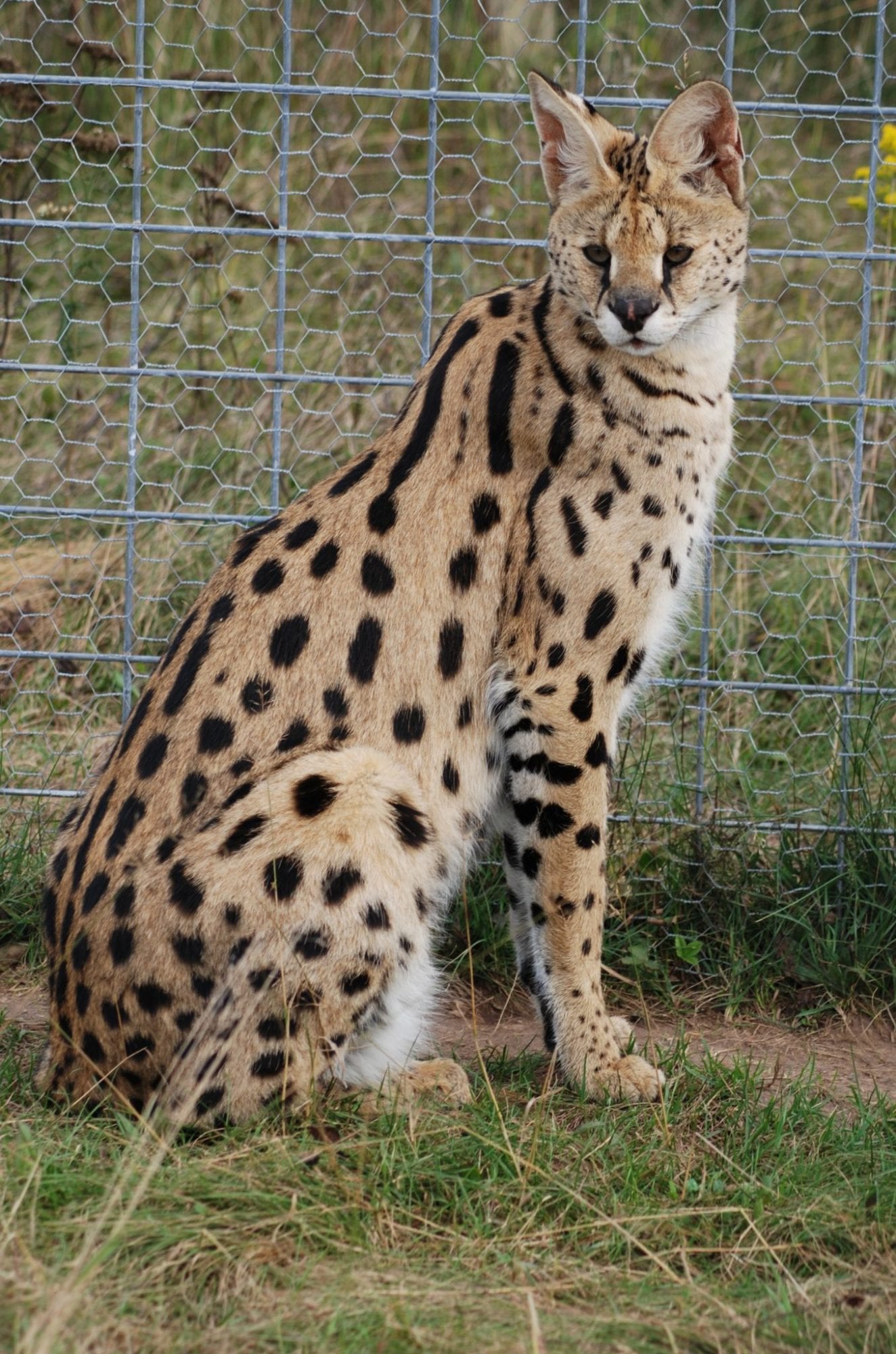
Although servals (a wild cat) are not included in the provincial Controlled Alien Species legislation, that doesn’t mean they should be kept as pets. Servals are wild animals. Native to many parts of Africa, servals roam savannahs and wetlands hunting for prey, and have a poor quality of life when kept as pets.
These wild cats are not much bigger than a medium-size dog, but they still retain their wild instincts and are cunning escape artists. They are difficult to contain in a home or enclosure setting, and pose a risk to their keepers and the public, and even native wildlife if they escape. Their own safety is also in jeopardy in captivity. Escaped servals have died by being hit by cars or of starvation, since they never had the opportunity to learn how to hunt.
In 2019, the BC SPCA seized 13 servals near Kamloops living in horrific conditions. Following months of specialized care, the BC SPCA received federal permits to send the servals to accredited sanctuaries in the U.S. The BC SPCA and over 6,600 supporters then campaigned the provincial Director, Fish & Wildlife to prohibit private serval ownership, breeding, display and transportation through existing exotic animal regulations. However, no government action has been taken to date.
Servals are strong, fast and have an incredible capacity for jumping. In the wild, servals will leap high into the air to catch flying birds, and can slap fish hard enough to stun them. They are not easily house-trained, and will frequently mark their territory with urine. It is extremely challenging to provide for the nutritional and veterinary needs of a wild cat like a serval in captivity. Without their needs met, they experience poor welfare. There are no accredited sanctuaries in Canada for servals. Their breeding is unregulated and animal welfare organizations are not equipped to house these wild cats.
The BC SPCA has always opposed the declawing of cats. Declawing painfully removes the nails and bones of the toes – comparable to amputating human’s fingers at the last knuckle. In the past, servals were declawed when kept as pets, but declawing has since been banned by the College of Veterinarians of British Columbia (CVBC). This means servals pose an even greater risk to people and pets in the home. They may scratch while attempting to play, or out of frustration because their wild needs aren’t met.
After decades of advocacy by the BC SPCA and our dedicated supporters, the Controlled Alien Species Regulation (CAS) was enacted in 2008, but it included only large exotic cats that posed a public safety risk. Now the provincial government has added all exotic cats, including servals, caracals, leopard cats, ocelots and more. This change prohibits transportation and captive breeding, phasing out future private ownership of all non-native and non-domestic cat species as pets.
As of May 1, 2026, no exotic cats can be bred or transported into British Columbia and exploited for profit. Exotic cats currently kept as pets will be allowed to stay with their guardians for the remainder of their lives, provided that their guardians obtain a free personal possession permit and abide by basic care and safety requirements. Permitted owners cannot display or have their exotic cats in contact with the public. The ban is intended to ensure that no more exotic cats are brought or born into captivity and forced to live as pets where their needs cannot truly be met. Under the Regulations, the BC Conservation Officer Service will now have the authority to investigate escaped exotic cats, a situation that happens all too often. All existing exotic cats, and hybrids up to 4 generations, will have to be permitted under specific conditions and owners have until May 1, 2027 to apply to the Ministry for permits.
The BC SPCA encourages all municipalities and governments to adopt exotic pet laws that prohibit the keeping of servals and other exotic animals.
Subscribe to the BC SPCA’s WildSense e-newsletter for more information:
The BC SPCA uses your personal information to update you on our work for animals as well as for advertising and analytics purposes. More information on uses and how to opt-out can be found in our Privacy Policy.