
Canada is one of the few countries that breeds, raises, and transports horses overseas for slaughter to meet the demand for fresh horse meat. Gentle draft horses live in poor conditions and are shipped by plane on trips lasting more than 20 hours. Since 2013, Canada has exported more than 50,000 horses. From 2023-2025, between 1,800 and 3,200 horses were exported for slaughter each year.
Ending live horse export would stop the breeding of horses for this industry and it would not affect horses sold at auction. These horses are purpose-bred for export because importing countries require strict health standards.
The BC SPCA has been working on this issue since 2021. In 2023 Tim Louis, M.P. introduced Private Member’s Bill, C‑355 to the House of Commons to prohibit the export of horses for slaughter. The Prime Minister’s Office expressed support for this Bill, and it progressed to its first reading in the Senate. Unfortunately, the Bill hit a roadblock when Parliament prorogued (paused) in 2025, and it was not reintroduced in the new Parliament. After the 2025 federal election, 117 new MPs entered Parliament, more than one‑third of the House of Commons. The other two‑thirds have not heard from you about the live horse export issue since 2024. Your voice can help put this critical issue back on their radar.
Take action
We recognize that over the years, many members of our animal-loving community have signed several petitions to make this ban a reality. These efforts have not gone unnoticed, but the new Parliament needs to understand that this issue is still important to you. A personal phone call or email to your Member of Parliament (MP) will mean the most.
With your ongoing support and action, we’ll continue advocating for these important changes with our new federal government.
Canadians across the country continue to speak out against this practice. A national poll* from April 2024 found that only 22% of Canadians oppose ending live horse exports. Support for a ban is strong in Alberta; 78% of Albertans no longer want horses from their province shipped overseas. Among Indigenous people in Canada, 71% support banning this practice.
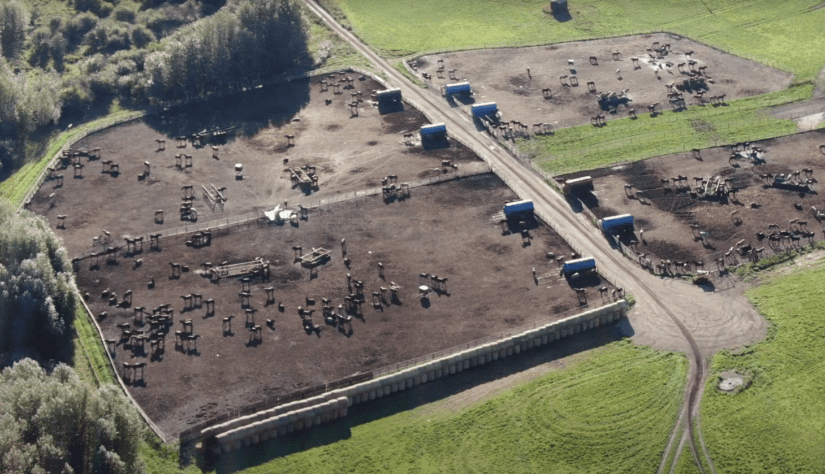
Where the journey begins
At the airport, the horses may sit on the tarmac for hours before being loaded onto the plane. Before loading, three to four horses are put into a single shipping crate, which is smaller than the average horse stall. In these tight spaces, horses can easily injure one another, lose their balance, or fall and be unable to get back up. Current international airline transport regulations require horses to be able to stand in a comfortable position without coming into contact with the top of the crate. However, eyewitnesses often report crates that are too short for the horses to stand comfortably without their ears touching or pushing through the top of the crate.
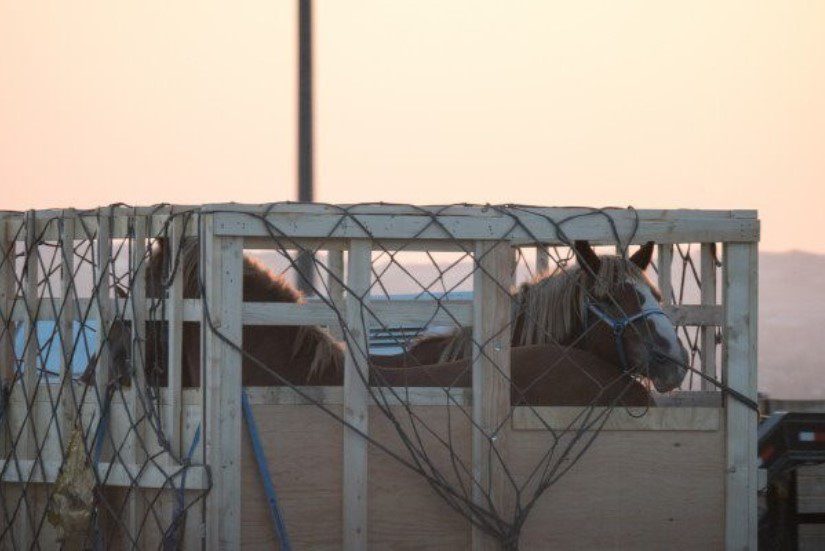
Horses fly in these crates without feed, water, or rest for the entire journey. The flight itself lasts 10 to 13 hours and may include a refueling stop in Alaska, which adds another two to three hours to their long journey. For international export, the typical time without feed, water, and rest for these horses is 20 to 22 hours, but there have been cases recorded that exceed this.
As the journey gets longer, the risk of injury, dehydration, and fatigue increases. Horses evolved to graze and normally spend over 65 per cent of their day eating. When they are not fed regularly, they face a much higher risk for painful and potentially life-threatening conditions such as gastric ulcers and colic and will show signs of stress.
Under current regulations, it is legal to transport horses up to 28 hours without providing feed, water, or rest. However, a 2024 report (PDF) by Animal Justice found that several flights exceed this maximum time limit. The BC SPCA strongly advocates that no animal should be transported without feed, water, or rest for more than eight hours, and that no horses should be flown under such circumstances.
The latest report (PDF) from Animal Justice shows that, between September 2024 and September 2025, horses transported to Japan for slaughter experienced severe welfare issues. At least nine horses died during transport. Another 29 collapsed during flights, and two of those were injured so badly that they had to be euthanized after landing. In addition, more than 290 horses suffered various injuries or illnesses. Horses suffered from high fevers, bleeding wounds, severe leg injuries, and, in some instances, horses arriving with missing hooves or parts of their ears.
Developments in the fight to end Canada’s live horse export
2025
- January 6 – Prorogation puts Parliament on hold.
- December 15th – The new Parliament needs to hear from you. Contact your Member of Parliament (MP).
2024
- December 16 – Three-year anniversary of the Minister of Agriculture’s mandate letter from the Prime Minister to ban the live export of horses overseas for slaughter.
- December – New data reveals another death and further injuries during shipments.
- September – New data shows that 21 horses died in a single year during transport.
- June – New data reveals shipments are regularly exceeding the legal limit for transport duration without feed, water, or rest.
- May 21 – The first reading of Bill C-355 in the Senate was completed.
- May 9 – The third reading for Bill C-355 in the House of Commons was completed and referred to the Senate.
- April 29 – The Standing Committee on Agriculture and Agri-Food completed their study of the bill and agrees to report the bill back to the House of Commons with amendments.
- February – April – The Standing Committee on Agriculture and Agri-Food met to discuss Bill C-355.
- January 31 – The second reading for Bill C-355 in the House of Commons was completed and passed the vote to be sent to the Standing Committee on Agriculture and Agri-Food for consideration.
2023
- November 20 – Bill C-355 was read for the second time and debated by our representatives in the House of Commons.
- September 19 – Tim Louis, M.P. introduced Private Member’s Bill C-355 to the House of Commons to prohibit the export of horses for slaughter. The Prime Minister’s Office has expressed their support for this bill.
- June 21 – Senator Pierre Dalphond introduced Bill S-270 to Senate to prohibit live horse export.
- March 29 – Government response to petition e-4190 was tabled, stating they are working to implement the mandate letter to ban live horse export.
- February 13 – Petition e-4190 presented to the House of Commons by MP Alistair MacGregor.
- February 7– Petition e-4190 closed with a total of 36,175 signatures.
2022
- November 15 – BC SPCA sent a letter to the Minister of Agriculture and Agri-Food asking about the status of their mandate to ban live horse export, requesting an updated timeline for banning the practice.
- November 9 – CHDC initiated another federal petition (e-4190) calling on the Minister of Agriculture and Agri-Food to halt the live export of horses for slaughter, consistent with the Minister’s mandate letter.
2021
- December 16 – Banning the live export of horses for slaughter was included in the Prime Minister’s mandate letter to the Minister of Agriculture and Agri-Food.
- August 15 – The government was unable to table a response to the petition before Parliament was dissolved.
- June 22 – Petition e-3187 presented to the House of Commons by MP Nathaniel Erskine-Smith.
- June 18 – Petition e-3187 closed with a total of 77,684 signatures, making it the most-signed federal e-petition relating to animals in history.
- April 29 – BC SPCA joined the CHDC and other animal protection organizations in sending a letter to the federal government urging action on this issue.
- February 18 – Canadian Horse Defence Coalition (CHDC) initiated a federal petition (e-3187) calling upon the government to stop air shipments of horses exported for human consumption, due to ongoing animal welfare concerns.
Additional resources
*ResearchCo. poll conducted for the BC SPCA April 3-5, 2024 (n=1,000, margin of error +/-3.1%, 19 times out of 20)